


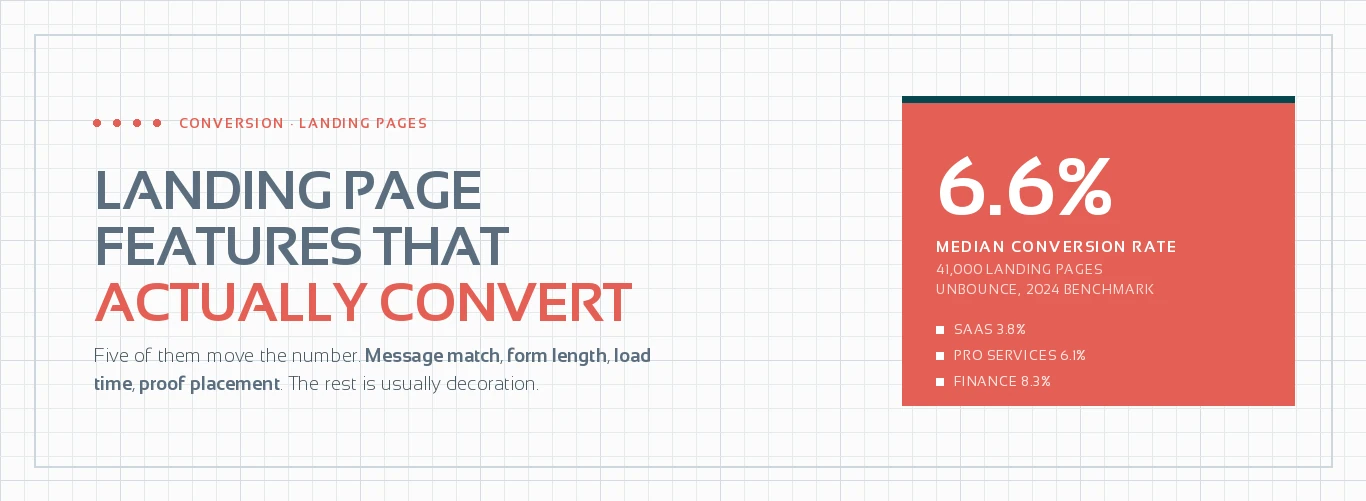
Five landing page features move conversion: a headline that repeats the ad’s promise, one offer with one action, a form that asks only what sales will use, proof placed next to the ask, and a page that loads in under 2.5 seconds. Features beyond those five are usually decoration.
What counts as a landing page feature
A landing page feature is any element that changes whether a visitor completes the action you built the page for. Headline, offer, form, proof and load time qualify. Background video and a three-panel company history do not, because removing them rarely moves the number in either direction.
That distinction matters because most landing page advice lists elements where it should be naming decisions. “Compelling visuals” is not something you can act on this afternoon. A form field asking for a phone number your sales team never calls is.
What is a good landing page conversion rate?
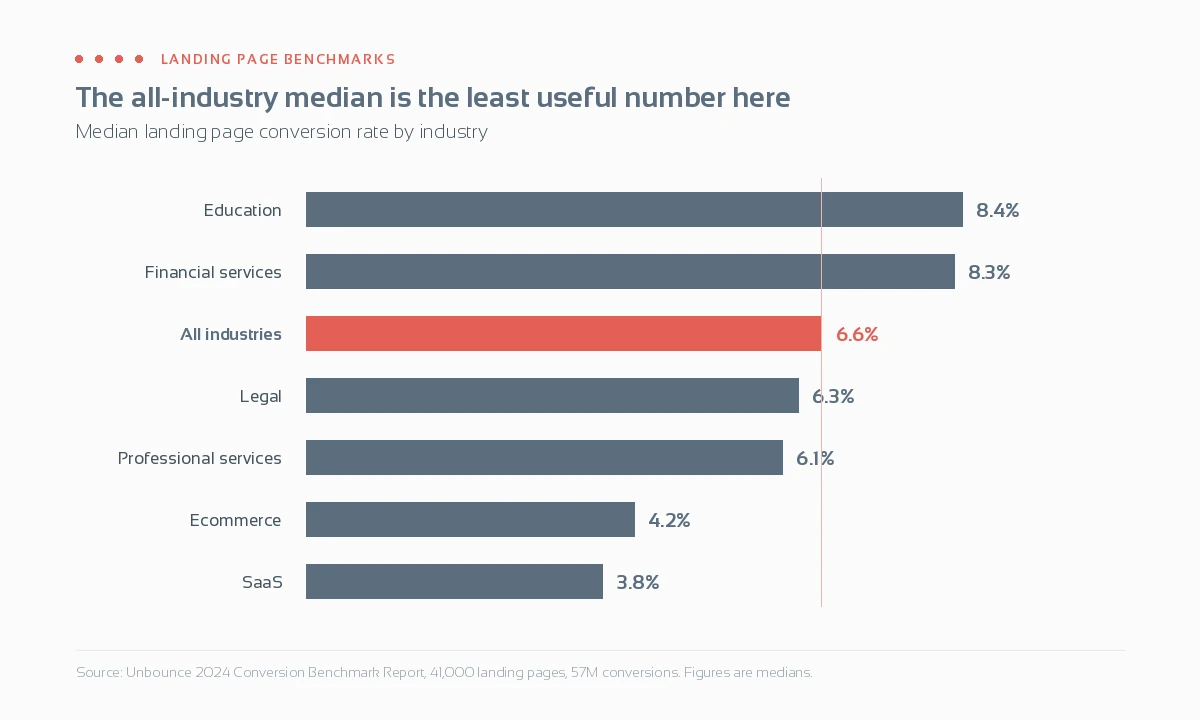
Across 41,000 landing pages and 57 million conversions, the median conversion rate is 6.6% (Unbounce 2024 Conversion Benchmark Report, figures reported as medians, page updated July 25, 2025).
The spread by industry is wide enough that the overall median is close to useless as a target:
| Industry | Median conversion rate |
|---|---|
| Education | 8.4% |
| Financial services | 8.3% |
| Legal | 6.3% |
| Professional services | 6.1% |
| Ecommerce | 4.2% |
| SaaS | 3.8% |
| All industries | 6.6% |
The same 5% conversion rate beats the SaaS median by 1.2 percentage points and trails the financial services median by 3.3. Benchmark against your own category and your own previous page, and treat the all-industry figure as trivia.
The five features that move conversion
A headline that repeats the ad’s promise. If the ad says “free site survey in 48 hours” and the page says “Trusted since 1994,” you have asked the visitor to work out whether they are in the right place. Most will not bother. Use the ad’s own words in the page’s first line, including the specific number or timeframe.
One offer, one action. Decide what the page is for before you build it. A page built to generate demo requests should offer a demo request. Adding a newsletter signup, a pricing link and a chat widget gives the visitor four ways to not do the thing you wanted. Count the clickable elements on your page. If there is more than one that leads anywhere other than the conversion, you have a reason to justify for each.
A form that asks only what sales will use. Go through your form field by field with whoever works the leads and ask what they do with each answer. Fields that exist because someone wanted the data in a report, rather than because someone acts on it, are costing you submissions for no return.
Proof sitting next to the ask. A named customer quote, a result with its timeframe, or a recognizable logo belongs beside the form. Proof placed three screens below the conversion point only reaches people who already scrolled past the decision.
A page that loads before people give up. Google treats a Largest Contentful Paint of 2.5 seconds or less as good, measured at the 75th percentile of page loads; 2.5 to 4.0 seconds needs improvement, and above 4.0 seconds is poor (web.dev). Landing pages fail this more often than main sites do, usually because someone added a hero video or a tag manager container full of scripts nobody audits.
Google scores your landing page, and it does not look at your conversions
Landing page experience is one of three Quality Score components in Google Ads, alongside expected clickthrough rate and ad relevance. Google defines it as “how relevant and useful your landing page is to people who click your ad,” and says it is affected by whether the page delivers what the searcher was looking for, how easy the site is to use on mobile, and how quickly the page loads (Google Ads Help).
The same documentation states that conversion rate does not affect landing page experience status.
Read those two things together and you get the trap. A page can earn an “above average” landing page experience, lower your cost per click, and still convert at half what it should. Quality Score is measuring relevance, and relevance is a cheaper-traffic problem. Whether the page persuades anyone is a separate question, and nothing in the Google Ads interface will answer it for you. Both problems are worth fixing, though only one of them will ever show up in your account.
The features that do not earn their place
- Carousels and sliders. Visitors see the first panel. Everything you put in panels two through five is work nobody reads.
- A full navigation bar. On a page you are paying to send traffic to, site navigation is a set of exits.
- Secondary calls to action. “Learn more” next to “book a demo” splits the click and tells you nothing about intent when someone takes it.
- Company history above the fold. Your founding year is not the reason anyone fills in a form. Move it below the conversion point or cut it.
- “We’ll be in touch.” Replace it with when. “Someone will call you within one business day” sets an expectation the visitor can decide to accept.
What to test, and in what order
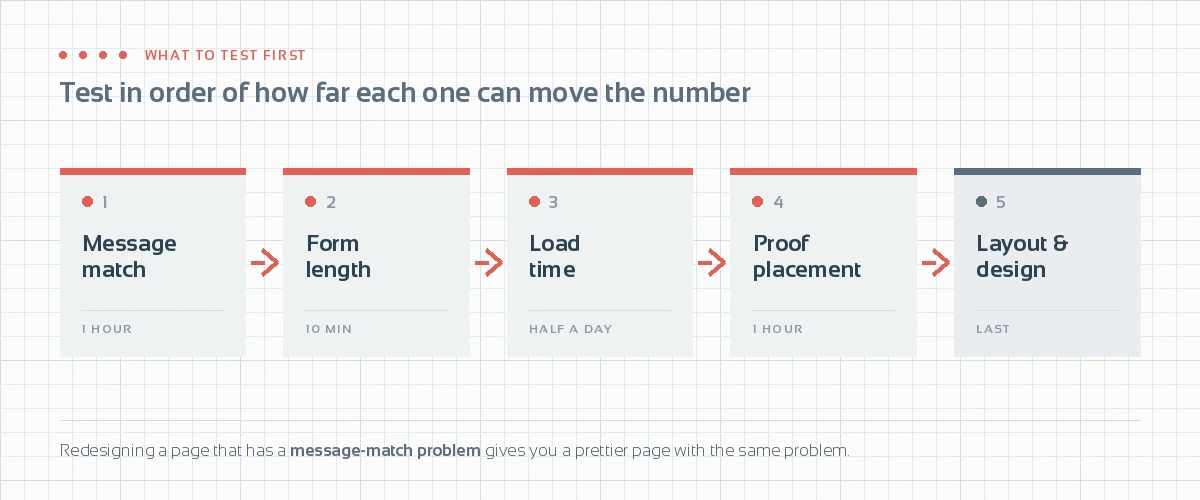
Test in the order of how much each change can move the number, which is roughly the order of how cheap it is to do.
- Message match. Rewrite the headline to carry the ad’s promise word for word. Costs an hour, and it is the most common gap we find.
- Form length. Remove every field whose answer nobody acts on. Costs ten minutes.
- Load time. Measure the page, then remove whatever is slowest. Usually a video, a font stack or an unaudited tag container.
- Proof placement. Move your strongest proof point beside the form.
- Layout and design. Do this last. Redesigning a page that has a message-match problem gives you a prettier page with the same problem.
Change one thing at a time and give each test enough traffic to read. A page with 400 visits a month will not produce a trustworthy result in a week, and running four changes at once means you learn nothing about which one worked.
What this looked like for one client
For a Virginia custom home builder, we rebuilt lead generation across paid search, paid social, connected TV, pre-roll, display and Pinterest, planned as one connected system with the landing experience built in from the start.
Against a 32-week baseline of 163 weekly leads, weekly leads reached 234 (+43% year over year). Cost per acquisition fell 64% year over year. Lead conversion rate moved from 4.02% to 5.7% (+1.68 percentage points, measured across the 23-week campaign period). The first year produced 155 home sales and more than $50 million in sales attributed to the lead generation campaign, at an advertising-to-sales ratio of 0.48%.
What is worth copying there is the sequence: we fixed where the traffic was going and what it landed on before spending anything on how the page looked.
FAQs
What are the most important features of a landing page?
A headline that matches the ad, a single offer with a single action, a short form, proof next to the form, and a load time under 2.5 seconds. Those five account for most of the variance in how a page performs.
How many form fields should a landing page have?
As many as your sales team acts on, and no more. Rather than targeting a number, audit each field with the person who works the leads and delete any whose answer changes nothing about what happens next.
What is a good conversion rate for a landing page?
The median across 41,000 pages is 6.6%, but category medians range from 3.8% for SaaS to 8.4% for education (Unbounce 2024 Conversion Benchmark Report). Compare against your category and your own previous page.
Does landing page design affect Google Ads performance?
Yes. Landing page experience is one of three Quality Score components, which affects what you pay per click. Google says it is driven by relevance, mobile usability and load speed, and that your conversion rate does not factor into it.
Should a landing page have navigation?
Generally no. On a page you are paying to drive traffic to, navigation links are exits. Keep them for organic landing pages where browsing is part of the point.
Where this fits in your plan
We build landing pages as part of the campaign that feeds them, alongside the search campaign pointing at it and the channels sending the traffic, and we report on what the page did in the numbers your leadership already uses. You can see the good stuff first. If your pages are getting traffic and not much else, give us a shout.