



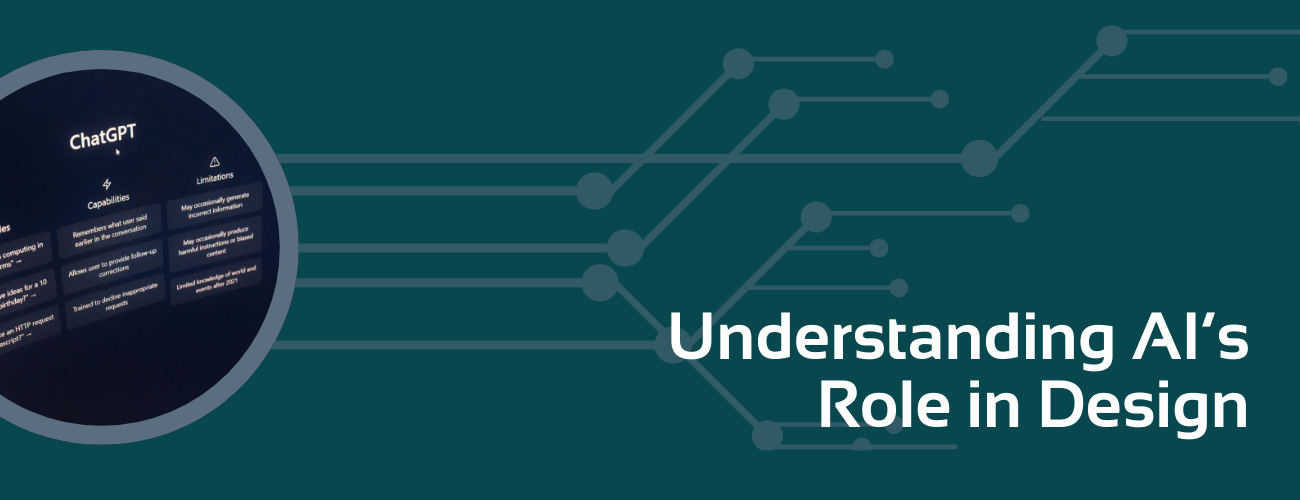
If you ask ten people what they think about AI, you’ll likely get ten very different answers. It’s a loaded term, influenced by years of speculation, excitement, and anxiety. We want to cut through the noise and better understand what AI actually does well and where it falls short in the creative design world.
What is AI?
AI, at least in its current form, isn’t really Artificial Intelligence. Because of decades of movies, books, video games, and pop culture, we have a warped perspective of what AI is capable of. ChatGPT, or any other Large Language Models (LLMs), aren’t sentient. Sorry, but you’re not having a conversation with HAL from 2001: A Space Odyssey.
According to Google, “Artificial intelligence allows a machine to simulate human intelligence to solve problems”. The keyword in that description is “simulate”. It simulates intelligence by recognizing patterns scraped from vast amounts of art, text, and data across the internet. For certain tasks, that’s fine, but when we talk about art, design, and creativity, things start to break down quickly.
AI Issues & Limitations
Any good graphic designer will tell you that design is more than just creating a pretty picture. It’s about conveying information to an audience in a way that resonates with them. That requires intent and the ability to understand context.
While someone with zero design experience can generate an image with AI tools, we have to ask:
- Does that image follow brand guidelines?
- Does it align with the company’s values?
- Is it legible and accurate in the information it conveys?
- Why does that person have six fingers?
At the end of the day, AI isn’t creative, and it’s not consistent. Generating multiple images with the same prompt will give you different results. Even if they are somewhat consistent, there are often details that are plain incorrect in a “really weird and uncanny” way.
Risks to Brand Reputation
Improper use of AI can damage your brand’s reputation and cost you money. Text-based models often struggle with consistency in long-form copy and can even “hallucinate” or falsify information.
Then there’s the copyright issue. AI companies have faced criticism for scraping copyrighted material to train their models. Currently, a class action lawsuit is moving forward against OpenAI for copyright infringement. The outcome of this case could have a massive effect on the future of AI and highlights the ethical concerns that come with its use.
What AI is Good At
So, is AI useless? No, of course not. When it comes to our work as designers, AI has real advantages when used as a tool rather than a replacement.
Early Concepting: It is helpful during mockup phases where speed matters more than precision.
Production Tasks: It assists with fixing or extending images, enhancing audio, and other time-consuming tasks.
Workflow Improvements: Automating repetitive tasks allows designers to spend more time on strategy and storytelling.
Data Analysis: AI can quickly process and summarize large amounts of data to spot patterns that inform design decisions.
In these cases, AI works best as a supplementary tool, not a substitute for human judgment.
Human Judgment Matters
Whether we like it or not, AI has caused major disruptions in the way we work. How you choose to use the technology is a personal decision. What matters most is taking the time to understand its strengths and limitations rather than falling victim to hype or fear.
If you incorporate AI into your workflow, consider your audience. If a brand stands for authenticity, using AI may not be the right choice. On the other hand, a tech company’s audience may be more receptive to it. At its best, AI is just another tool in the toolbox. The real value still comes from human judgment, intention, and our ability to make thoughtful, creative decisions.